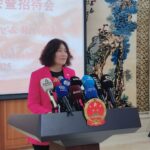
Mrs. Wiame Bounejar, spouse of the Italian Ambassador to Azerbaijan, embodies the modern spirit of diplomacy — well educated, graceful, engaged, and deeply connected to culture. In this interview with Azeri Observer, she shares how her studies in languages and international relations shaped her worldview and strengthened her belief in dialogue as the foundation of diplomacy. Speaking about her life alongside her husband, she discusses the art of balancing personal ambition with the public responsibilities that come with diplomatic life. Mrs. Bounejar explains how cultural diplomacy — culinary traditions and educational initiatives — has become her way of building bridges between Italy and Azerbaijan. Reflecting on life in Baku, she highlights the warmth of the Azerbaijani people, the beauty of local traditions, and the joy of shared experiences.
By Elena Kosolapova
Azeri Observer Staff Writer
Question: Could you tell us about your early education and what first sparked your interest in international relations, diplomacy, or cross-cultural work?
Answer: My academic journey began when I moved from Piedmont to Milan to pursue a bachelor’s degree in Linguistic Sciences for International Relations, focusing on Arabic and English. During my studies, I worked as a tutor for the Italian National Badminton Team. Shortly after, I joined the Consulate General of the Kingdom of Morocco while writing my thesis. After completing my undergraduate studies, I moved to Rome, where I obtained an international master’s in European Studies and European Institutions at Luiss University. At that point, I had to choose between continuing my studies in Bruges or remaining in Rome. I chose Rome, where I completed my master’s degree in International Relations with a major in Diplomacy and Security, writing my final thesis on Italian foreign policy in the Red Sea region. Throughout my academic and professional path, I have gained a wide range of experiences. I participated in two military exercises: one with the Italian Navy, where I served as policy advisor during a one-month navigation period, and another joint-forces exercise, where I held the role of public information advisor. Before moving to Baku, I worked as an officer at the Italian Ministry of Defense, a stimulating position closely related to international relations and cooperation with European institutions.
Q.: You have degrees in languages, international relations, and European Union studies, and you speak several foreign languages. How does this knowledge shape your worldview and your understanding of cross-cultural dialogue?
A.: My academic background fosters a strong sense of cultural awareness and global interconnectedness. Studying and working in multicultural environments taught me that dialogue and mutual understanding are the foundations of effective diplomacy. Speaking several languages has also allowed me to bridge cultural gaps, communicate with empathy, and approach international cooperation from a broader and more inclusive perspective.
Q.: Could you share how your own professional path intersected with your husband’s diplomatic career?
A.: My professional journey has always intertwined with my husband’s diplomatic career in a very natural way. We share a deep curiosity for the world and a passion for international affairs, which often overlap in our work and conversations. While he represents Italy abroad, my background in international relations and European studies lets me explore similar themes from a different angle. His career has become a real source of inspiration, fueling my ambition to keep growing and dreaming big. Living this experience together has enriched me both personally and professionally, giving me new perspectives that I’ll carry along my own path. Sharing the same interests has made our bond even stronger and turned our shared curiosity into a continuous exchange of ideas and motivation.

Q.: How do you balance your personal identity and ambitions with the representative public role that comes with being the Ambassador’s spouse?
A.: Finding balance between my personal identity and this public role is a rewarding but demanding journey. I see this role not as a limitation but as an extension of who I am — someone deeply interested in people, cultures, and international dialogue. Sometimes it can be difficult, as the role demands a lot of time and energy. But I believe it is essential to have someone who appreciates what you do while always supporting your individual path and motivating you. It’s important to remember that, before being a couple, we are first and foremost individuals with our own interests, desires, and ambitions, whatever they may be. Open communication and mutual support are key to growing together while respecting each other’s individuality. The role also gives me the unique opportunity to showcase different aspects of our country, which is a source of great pride. By embracing both my professional ambitions and the representational role, I’ve learned that personal growth and public service can complement each other beautifully when approached with authenticity and curiosity.
Q.: Every diplomatic posting comes with its own rhythm and surprises. What were your first impressions of Azerbaijan? What aspects of the country have fascinated or inspired you the most?
A.: Luca [Di Gianfrancesco, Italian Ambassador to Azerbaijan] and I met in Rome, and as someone not originally from the city, I often joke that living there felt a bit like a diplomatic posting. Every diplomatic posting has its own rhythm and surprises, and arriving in Azerbaijan was no exception. I was immediately struck by the country’s rich culture, its warmth, and the ambition of its people. Azerbaijan is a country with which we share strong economic and cultural ties. The recent visit of President Sergio Mattarella highlighted just how close our relationship is, reinforcing the positive connections that shape daily life here. It makes us smile and feel a little nostalgic when we enter a restaurant and hear Italian songs playing. People here have such warm hearts, always trying to make us feel at home, even many kilometers away from Italy.
Q.: Many diplomatic spouses describe their role as a “bridge” between the host country and their own. How do you experience that personally?
A.: I definitely experience my role as a bridge, and for me, it often comes through sharing culture in tangible ways. For example, I love transmitting culinary traditions, both from my home region of Piedmont and from across Italy. My grandmother was a chef in the Langhe, a UNESCO heritage area, and here at the residence, we try to bring her recipes to life for our Azerbaijani and international guests. It’s more than just food; it’s home, tradition, and history. On a linguistic level, I also enjoy connecting with students learning Italian. Having been a student myself not long ago, I understand how exciting it is to discover a new language, and I love fostering interest in our language and cultural heritage. Ambassadors handle political dossiers and maintain bilateral relations between institutions, and spouses play a key role in supporting these efforts. By helping to strengthen ties through cultural, social, and educational initiatives, we contribute in meaningful ways to the broader relationships our countries share.


Q.: In what ways have you been involved in the Embassy’s cultural diplomacy efforts such as events, exchanges, or public outreach? Which of these have you found most rewarding?
A.: I’m fully involved in the Embassy’s cultural diplomacy efforts. Before moving here, Luca and I visited Baku and immediately felt that there was so much cultural potential. The city had an indescribable charm, and we knew we wanted to contribute. From day one, we started working together on initiatives, such as the National Day celebrations. For the most recent celebration, I had the pleasure of creating the concept centered around the twin relationship between Naples and Baku, symbolized by their two gulfs. Geographically distant but alike in warmth and hospitality, the two cities were brought together through this concept and presented with the help of a local company during the celebration. Today, it’s a beautiful installation that decorates the main hall of the residence. We have also attended major events side by side, such as COP29, which involved intense schedules and numerous ministerial visits. During the day, I supported Luca with delegations, and in the evening, we organized receptions together at the residence. There are no roles strictly assigned to spouses, so teamwork has been fundamental in every aspect. Beyond that, I am always very involved; we’ve noticed that working together allows us to achieve much more than one person could alone. During Italian Cuisine Week, for example, I enjoy contributing my creativity and have helped propose chefs to be invited. Even fun moments, like the Baku Marathon, for which I designed the Embassy team’s t-shirts, reinforce the value of collaboration and shared enthusiasm. Of course, the most significant and memorable moment was the recent visit of President Sergio Mattarella, a beautiful and demanding experience that highlighted the importance of engagement, coordination, and partnership. I truly believe that being fully involved in these activities is essential, as different perspectives only enrich and strengthen the final outcome.
Q.: What do you see as the most rewarding aspects of diplomatic life? Is it the opportunity to live in different countries, exposure to different cultures, or perhaps the chance to promote your country abroad?
A.: My passion has always been meeting new people and discovering new cultures. I believe that personal growth comes from understanding others, especially their differences. Similarities make us feel at home, but it is the differences that allow us to see the world through new perspectives and truly make a difference. For example, in just a year and a half in this role, I feel like a changed and evolving person – both personally and professionally – because I have learned to see myself through the eyes of the people I meet. Moreover, I have discovered the world of female spouses who are incredibly capable and have rich life experiences. From them, I am learning how strong women are across all countries and cultures, forming a chain that extends beyond our country of origin.

Q.: On the flip side, what have been the more difficult aspects of adapting to diplomatic life? Frequent moves, time away from familiar surroundings, or balancing personal ambitions with diplomatic duties?
A.: One of the most challenging aspects is adapting to a new routine. I’ve always been someone who moved quite a lot, even before meeting Luca. Since I was a child, I’ve experienced a mix of emotions every time I changed place. It’s exciting, but it’s also a leap into the unknown. Yet it helps you get to know yourself better; it’s a deeply introspective journey. Perhaps the hardest part, though, is the distance from friends and family. Time passes, and you realize you’re far away from them. In our case, however, it’s always comforting to feel that, no matter the distance, it’s as if we never really left. Another challenging aspect is finding the right balance between one’s personal ambitions and the professional life of one’s partner. This is a role that can easily absorb you in the act of representing your country abroad, but at the same time, it’s essential to stay focused on yourself. Otherwise, frustration can easily set in. It’s important to face this as a couple, to be aware, to motivate each other, and above all, not to lose sight of who you are in a context that has traditionally revolved around men. We should not limit ourselves to the traditional idea of being the “angel of the hearth,” but rather, we should embrace the idea that we are individuals sharing a path and that we can be anything we choose to be.
Q.: Outside of the official duties, what brings you joy and fulfillment in Azerbaijan? Have you discovered particular places, traditions, or aspects of local culture that have captured your heart?
A.: I’ve always loved sports. Running and racket sports, in particular, have always been a big part of my life. Luca and I enjoy doing outdoor activities together, and we often go for runs along the seaside. We live in the Old City, and sometimes I like to wander through its narrow streets, getting lost and discovering new corners. I love talking to people I meet along the way, especially when I stop by the antique shops and come across beautiful traditional pieces. This place has such a unique charm. And since I’m very fond of cats, my walks tend to take a little longer. I can’t resist stopping to pet every cat I see.

Q.: Looking ahead, how would you like to use your expertise in international cooperation and institutional relations in your personal and professional life?
A.: I’m already putting my expertise to use, as I’m often involved in the Embassy’s activities. Everything I do here is helping me grow both personally and professionally, and living in such a dynamic environment is definitely expanding my knowledge and perspective. When I return to work in the near future, I’ll be fortunate to bring with me an even broader set of skills and experiences, whether I decide to continue in the public sector or explore opportunities in the private sphere.
Q.: Finally, a question we ask all ambassadors’ spouses. There’s a saying that behind every successful man stands a wise woman. How does this reflect your own life?
A.: I believe that saying belongs to another time. A life partner does not stand behind, but rather walks alongside. Luca and I face life step by step, always supporting one another, and that truly reflects our philosophy as a couple. We take joy in each other’s achievements as if they were our own. Luca’s professional success is also the result of his positivity and curiosity, and in the same way, he stands by me in every personal and professional choice. One aspect I particularly value and which is not always taken for granted is having a partner who truly shares success, who recognizes that good results often come from the exchange of ideas and from teamwork. In positions of responsibility, this ability to share and acknowledge another’s contributions is not always common, yet Luca does it naturally. We also feel very fortunate to have built genuine friendships around us and to have families who constantly support us, despite the distance. Their presence, even from afar, gives us a sense of stability and belonging that is essential in a life that is often in motion. I also believe that the role of the spouses, especially in diplomatic life, has evolved considerably. Today, they’re not only companions but active participants in shaping dialogue, fostering understanding, and building bridges between cultures. We provide qualities of empathy, perspective, and resilience that enrich the human dimension of diplomacy. It is important to value these contributions and to see women as partners walking side by side, sharing both responsibilities and aspirations.